
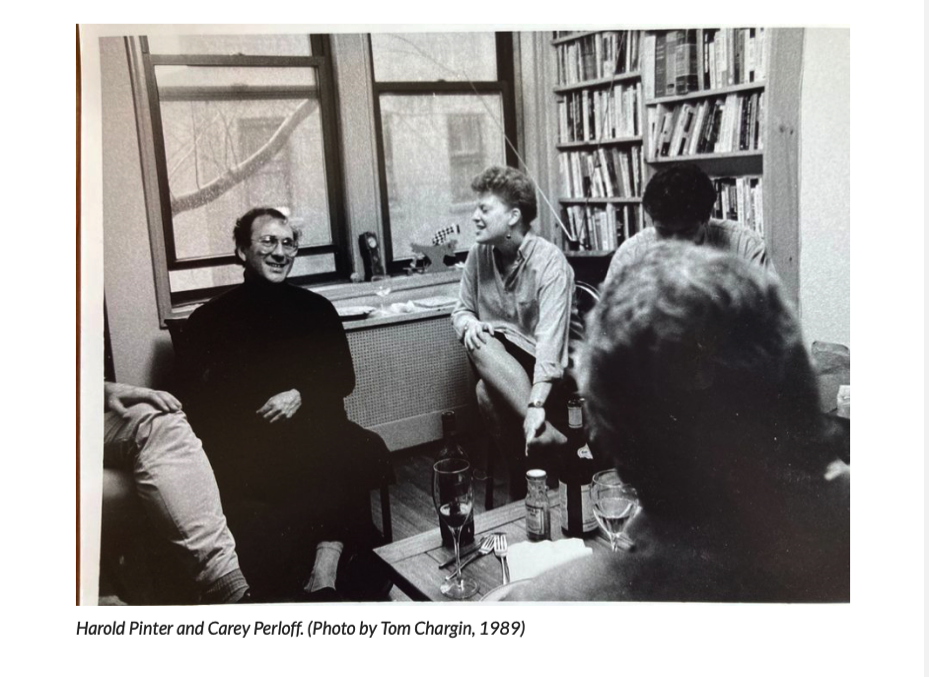
Carey Perloff, Harold Pinter during rehearsals at Classic Stage Company in 1989 Photo by Tom Chargin

Tom Stoppard, Carey Perloff, 2012, in Rehearsal for THE HARD PROBLEM at A.C.T. Photo by Kevin Berne

ABOUT THE BOOK...
This study links two seemingly divergent artists in a revisionist context that sheds new light on both. While it is generally assumed that Harold Pinter and Tom Stoppard sit at opposite ends of the aesthetic, theatrical and political spectrum, I argue that by examining them together, many new insights can be gleaned about their work and their place in the theatrical canon. This contention is supported by my extensive archival information, arising from three decades of close collaboration with both playwrights.
It is my belief that a play yields its meaning most vividly and specifically through the actual process of casting, designing, rehearsing, staging and producing. Over the course of my career as a director and an Artistic Director, first at the Classic Stage Company in New York (from 1988-1992) and then at the American Conservatory Theater in San Francisco (1992-2018), I worked on numerous occasions with both Pinter and Stoppard in the rehearsal room and was able to develop an understanding of how to unlock the plays through practical and analytic means.
This book does not cover the entire oeuvre of either writer, but references the major plays while focusing on selected works as case studies for the understanding of fundamental “rules of play” pertaining to each writer. By reexamining their artistic biographies, and in particular by teasing out the fascinating impact that being Jewish (and thus “outsiders”) had on the nature of Pinter and Stoppard's work, I provide new ways of positioning their plays for the current moment.
This reevaluation of Pinter and Stoppard's work moves beyond academic notions of “postmodern” and “realistic” drama to provide a contemporary director's point of view on the way their work functions today as drama on stage. Thirty years after the major criticism on both playwrights first emerged, the time has come for a fresh examination of the unique contribution of their work in the twenty-first century.
THE MARTIN E. SEGAL THEATRE CENTER
presents
SEGAL TALKS with Carey Perloff
A conversation about her new book
Pinter and Stoppard: A Director's View
Moderator: Frank Hentschker, Director, MESTC
The Graduate Center CUNY
Broadcast Live December 6, 2021


Professor Dame Hermione Lee
Photo by Toilm Pilston
Michael Chabon

Green Apple Books PINTER AND STOPPARD: A DIRECTOR'S VIEW
June 2022 launch event
LA Times Interview:
"Tom Stoppard's Jewish roots: Carey Perloff on Broadway's acclaimed play of the season"
- Charles McNulty
November 28, 2022
"The more I've dug into Stoppard's biography, the clearer it has become that, in spite of appearing to be a quintessential Englishman, he's always been an outsider. . (He once said he occasionally feels like he's in England “on a press pass.) "
Excerpt from American Theater:
"Fragments, Loss, and Language: On the Jewishness of Pinter and Stoppard
In her new book Pinter and Stoppard: A Director’s View (Methuen Drama), Carey Perloff explores her collaborations and discoveries in the rehearsal room alongside two great English playwrights, with an eye to what future interpreters can learn about these writers and their work. In this excerpt, which has been condensed and edited for this context, she hones in one of Pinter and Stoppard’s less noted commonalities."
From The New Yorker...
The October 6 review in The New Yorker of Tom Stoppard's play Leopoldstadt cites Carey Perloff's new book Pinter and Stoppard: A Director's View
"Stoppard’s frequent collaborator Carey Perloff recently published “Pinter and Stoppard: A Director’s View,” and she spends a chapter discussing his not quite forgotten, always sort of known Jewishness, the way it emerged in past work as stories about doubles and twins, or heritage that is torn down and lost. Her book helped me think about where Stoppard’s experience surfaces in Hermann, a man who both knows and does not know his true situation, a man who thinks he has won the coin toss while the coin is still in the air."
Excerpt from the John Stokes' TLS Review:
"Directing, as Perloff conceives of it, “is an iterative process in which a script slowly reveals itself on stage through rigorous examination and the freedom to play and fail until solutions are reached which feel true to the spirit of the text”. The question is therefore: “How does a director uncover the laws governing the unique and mysterious world of a given play?” These “laws” or “rules of play” are the operating principles within a work that will allow it to generate a theatrical event; they are discovered in rehearsal and realized in performance. They are not universal and they shift with the shifting times, sometimes fundamentally. Stoppard, for instance, has said of Pinter that “he changed the ground rules” so you could no longer necessarily believe what a character might say, even on the most mundane level...."